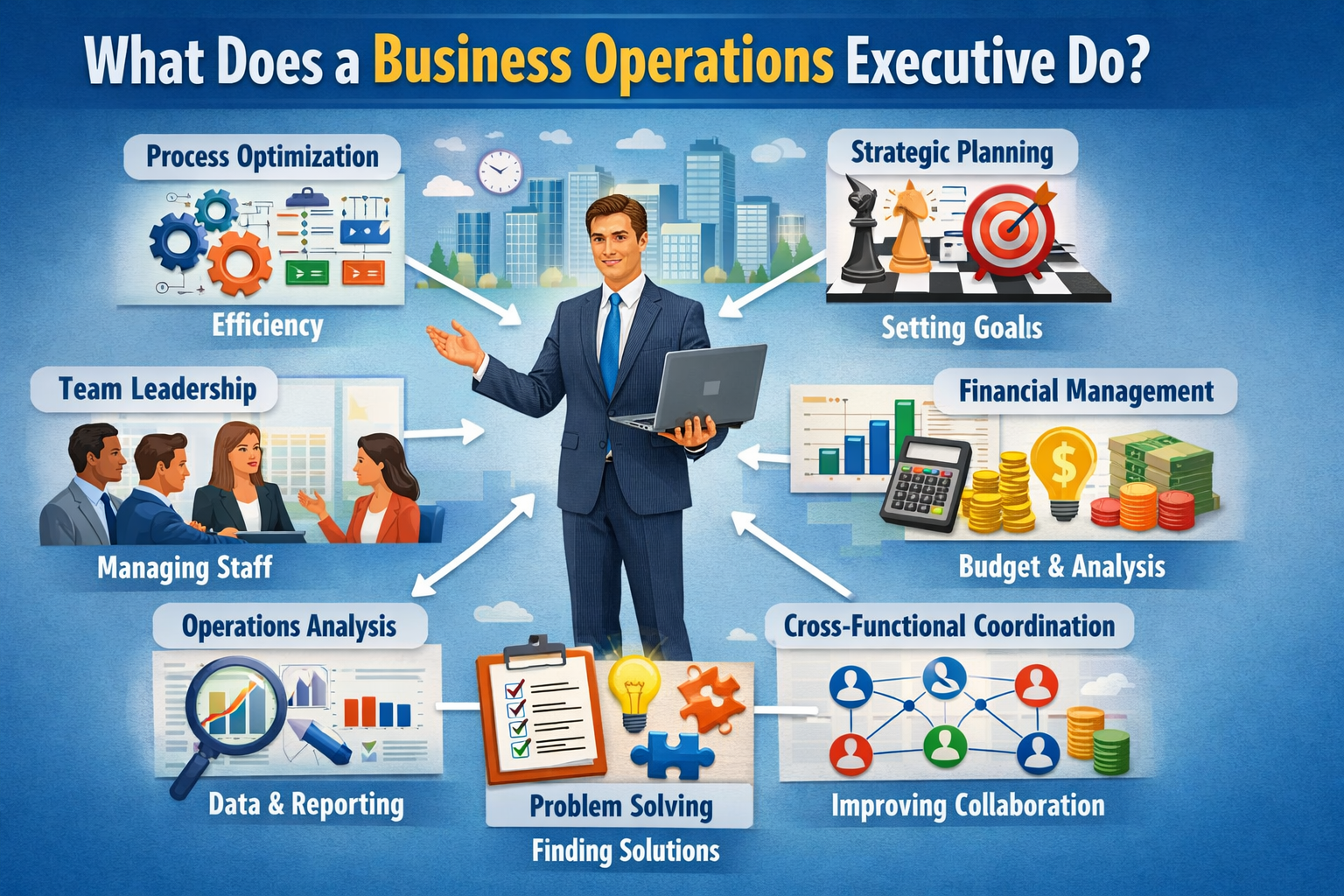
In today’s fast-paced and competitive business environment, companies rely heavily on professionals who can keep operations running smoothly and efficiently. One such vital role is that of a Business Operations Executive. This position acts as the backbone of an organization, ensuring that daily processes align with business goals, resources are used effectively, and teams work in coordination. Understanding what a Business Operations Executive does can help students, fresh graduates, and working professionals decide if this career path suits them.
Understanding the Role of a Business Operations Executive
A Business Operations Executive is responsible for managing, monitoring, and improving the internal operations of a company. Their main objective is to ensure that business activities are efficient, cost-effective, and aligned with the organization’s strategy. They work closely with management, department heads, and staff to streamline workflows and solve operational challenges.
Unlike roles that focus on a single department, Business Operations Executives usually have a cross-functional role. This means they may deal with finance, human resources, supply chain, administration, and customer service, depending on the organization’s size and industry.
Key Responsibilities of a Business Operations Executive
The duties of a Business Operations Executive can vary, but some core responsibilities are common across most organizations.
One major responsibility is process management and improvement. Business Operations Executives analyze existing workflows to identify inefficiencies, delays, or unnecessary costs. Based on their findings, they suggest and implement improvements to enhance productivity and quality.
Another important task is coordination between departments. They act as a bridge between different teams, ensuring that everyone is aligned with company objectives. This coordination helps prevent miscommunication and ensures smooth execution of projects and daily tasks.
They are also involved in planning and strategy support. While they may not always define company strategy, they help execute it by translating high-level goals into actionable operational plans. This includes setting timelines, allocating resources, and tracking progress.
Data analysis and reporting is another crucial part of the role. Business Operations Executives collect and analyze data related to performance, costs, and efficiency. They prepare reports for management that support informed decision-making.
In many organizations, they also handle vendor and stakeholder management. This includes coordinating with suppliers, service providers, and external partners to ensure timely delivery and quality standards.
Skills Required for a Business Operations Executive
To succeed as a Business Operations Executive, a combination of technical and soft skills is essential.
Strong organizational and planning skills are critical, as the role involves managing multiple tasks and priorities simultaneously. The ability to structure work and meet deadlines ensures smooth operations.
Analytical thinking is equally important. Business Operations Executives must interpret data, identify patterns, and solve complex operational problems. This skill helps them make decisions that improve efficiency and reduce costs.
Effective communication skills are a must, as the role requires regular interaction with team members, managers, and external stakeholders. Clear communication helps in aligning goals and resolving issues quickly.
Leadership and teamwork abilities are also valuable. Even if the role is not a senior management position, it often involves guiding teams, influencing decisions, and motivating others to adopt new processes.
Additionally, basic financial understanding and proficiency with tools such as spreadsheets, project management software, and reporting systems are highly beneficial.
Educational Background and Qualifications
Most Business Operations Executives hold a bachelor’s degree in fields such as business administration, management, commerce, economics, or operations management. Some employers prefer candidates with postgraduate qualifications like an MBA, especially for senior-level roles.
Certifications in operations management, project management, or process improvement can add value and improve job prospects. However, practical experience and problem-solving ability often matter just as much as formal education.
Career Path and Growth Opportunities
A career as a Business Operations Executive offers strong growth potential. Entry-level professionals often start as operations coordinators or analysts. With experience, they can move into roles such as Senior Operations Executive, Operations Manager, Business Manager, or Strategy Manager.
In larger organizations, experienced professionals may advance to leadership positions such as Head of Operations or Chief Operating Officer. The skills gained in this role are transferable across industries, making it a flexible and stable career choice.
Importance of Business Operations Executives in an Organization
Business Operations Executives play a crucial role in ensuring that a company functions efficiently. By optimizing processes and improving coordination, they help reduce operational costs and increase productivity. Their work directly impacts customer satisfaction, employee performance, and overall profitability.
In times of growth or change, such as expansion or digital transformation, Business Operations Executives are especially important. They help manage transitions smoothly by redesigning processes and ensuring minimal disruption to daily operations.
Is Business Operations Executive a Good Career Choice?
For individuals who enjoy problem-solving, organization, and working across multiple business areas, this role can be highly rewarding. It offers exposure to different functions within an organization and provides a strong foundation for leadership roles in the future.
The demand for skilled operations professionals continues to grow as companies focus more on efficiency, scalability, and performance. This makes the role of a Business Operations Executive both relevant and future-proof.
Conclusion
A Business Operations Executive is a key professional responsible for keeping an organization’s internal processes running smoothly and efficiently. From improving workflows and coordinating teams to analyzing data and supporting strategy, their role touches almost every part of the business. With the right skills, education, and experience, this career path offers stability, growth, and the opportunity to make a meaningful impact on organizational success.